The recent IOCR report highlighted a key knowledge gap in our understanding of the ocean carbon cycle as the role of ocean biological processes in storing carbon in the ocean interior. Within our international community, there is widespread interest in addressing this gap and understanding carbon processes, which can be seen in the investigations of programmes and projects conducting diverse observations in various biomes on a global scale.
With the 2026 Ocean Sciences Meeting drawing scientists from around the world to Glasgow, an international workshop was organised to take advantage of stakeholders coming to the city. With an objective to pool knowledge and define key steps in further advancing the understanding of biological processes in storing carbon, the workshop was led by Adrian Martin who serves on the OceanICU Scientific Advisory Board and was held at Heriot Watt with support from the Scottish MAST project. Other projects and programmes involved included: PICCOLO, Biopole and BioCarbon from the UK, the French project APERO, Australia-based SOLACE, EXPORTS funded by NASA, and Jetzon as well as OceanICU.
The workshop programme divided the biological pump into a series of key processes such as particle production, export, and grazing with the aim to assemble expert groups in each area to consider frontier questions. There were multiple breakout sessions and a lively poster session. OceanICU consortium members who attended, and of whom are pictured below, are: Giorgio Dall’Olmo, Yixin Zhao, Andre Visser, Richard Sanders, Alex Poulton, Ben Gustafson, Pauline Le Coq, Christian Tamburini, Elodie Jacob, Rebecca Millingon, Hannah Haines (standing, left to right) and Stephanie Henson, Natalya Gallo, Sarah Cryer, Nathan Briggs and Miriam Seifert (left to right, front row).
For the who’s who, please see above
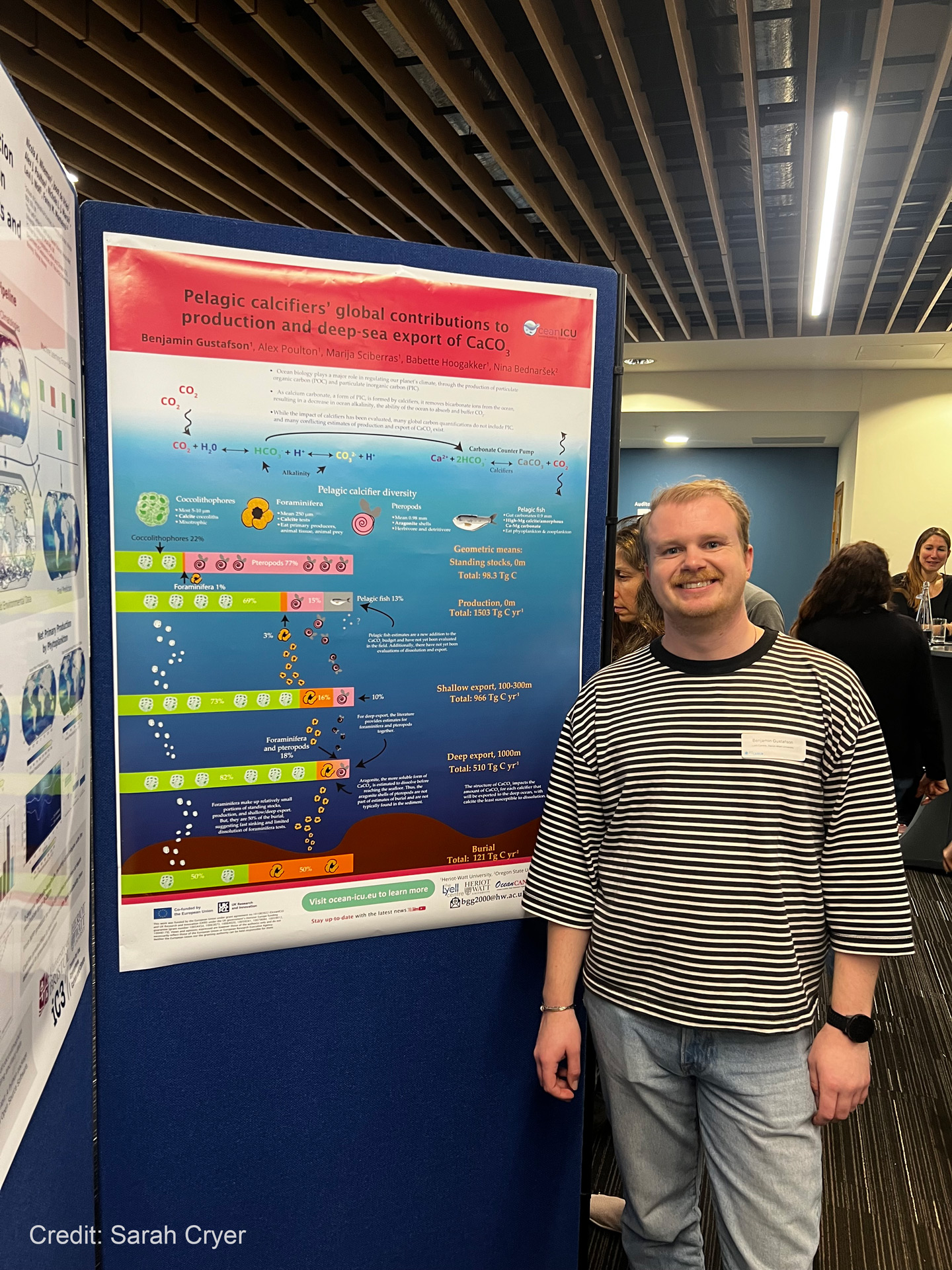
The event included a poster session where colleagues presented results from their project work including research focussed on the microbial c pump and calcite processes in the ocean, as seen below.
Ben Gustason
Helen Powley
In addition, a listening activity was chaired by Natalya Gallo to identify key priorities and how to best address them. This exercise supports a project ambition of producing a set of policy briefs from the collaborative outcomes of the workshop. Featuring priorities defined through consensus from this large international community, the briefs will provide funding agencies with important information on the current understanding of the role of marine biology in helping the Ocean store carbon and what the next steps are to close the knowledge gap as highlighted in the ICOR report. This activity also supports one of OceanICU’s expected impacts: Better coordination of existing activities and future calls focussed on clearly establishing the role of ocean biological processes in the global carbon cycle.
Natalya Gallo (right) sharing her work with Alex Poulton (left)
Stay tuned for the publication of the policy briefs later this year and for more news about the outcomes of this important workshop.