By Emma Dolmaire
Stoichiometry is the study of the proportions of elements in biochemical processes and interactions. It has led to a well-used constant in marine ecology called the Redfield ratio. The Redfield ratio is the atomic ratio of carbon, nitrogen and phosphate assumed to be globally constant in marine particulate matter (seston) and equal to C₁₀₆:N₁₆:P₁. It has often been used as a proxy to estimate carbon fluxes in nitrogen-based ecosystem models.
Why is stoichiometry so important in marine ecology and to understand the carbon cycle?
The carbon cycle in the ocean is intrinsically linked to cycles of other elements, namely nitrogen and phosphate, especially in the biosphere. Carbon, nitrogen and phosphate constitute the main elements found in biological material, including proteins and nucleic acids (DNA and RNA), however nitrogen and phosphate are in limited supply in the ocean. This means that many biological processes involving carbon (for example photosynthesis) are constrained by the relative proportions of nitrogen and phosphate in the environment.

Using stoichiometry to improve ocean carbon sequestration estimates…
As part of my work for the OceanICU project, I have been developing an algorithm to convert outputs from nitrogen-based ecosystem models into carbon. Working at the University of Strathclyde (Glasgow, Scotland), the objective was to use the model StrathE2E to understand the effect of fishing on carbon sequestration. However, StrathE2E, like many other ecosystem models, is written in nitrogen mass units instead of carbon and we decided to contemplate the possibility that a nitrogen-to-carbon conversion could be more complex than using a simple constant of proportionality.
Why can’t we use the Redfield ratio to convert nitrogen into carbon in ecosystem models?
Carbon-nitrogen data collected across the marine food web revealed that the C:N ratio of organisms slowly decreases when going up trophic levels (see graph). This suggests that organisms feeding on other organisms may not need or may not be able to assimilate carbon with the same efficiency as nitrogen, causing their C:N ratio to be slightly lower than their prey’s. In these observations, phytoplankton seems to be the only functional group with a ratio close to the Redfield ratio.
A new algorithm to compute carbon fluxes from a nitrogen-based ecosystem model!
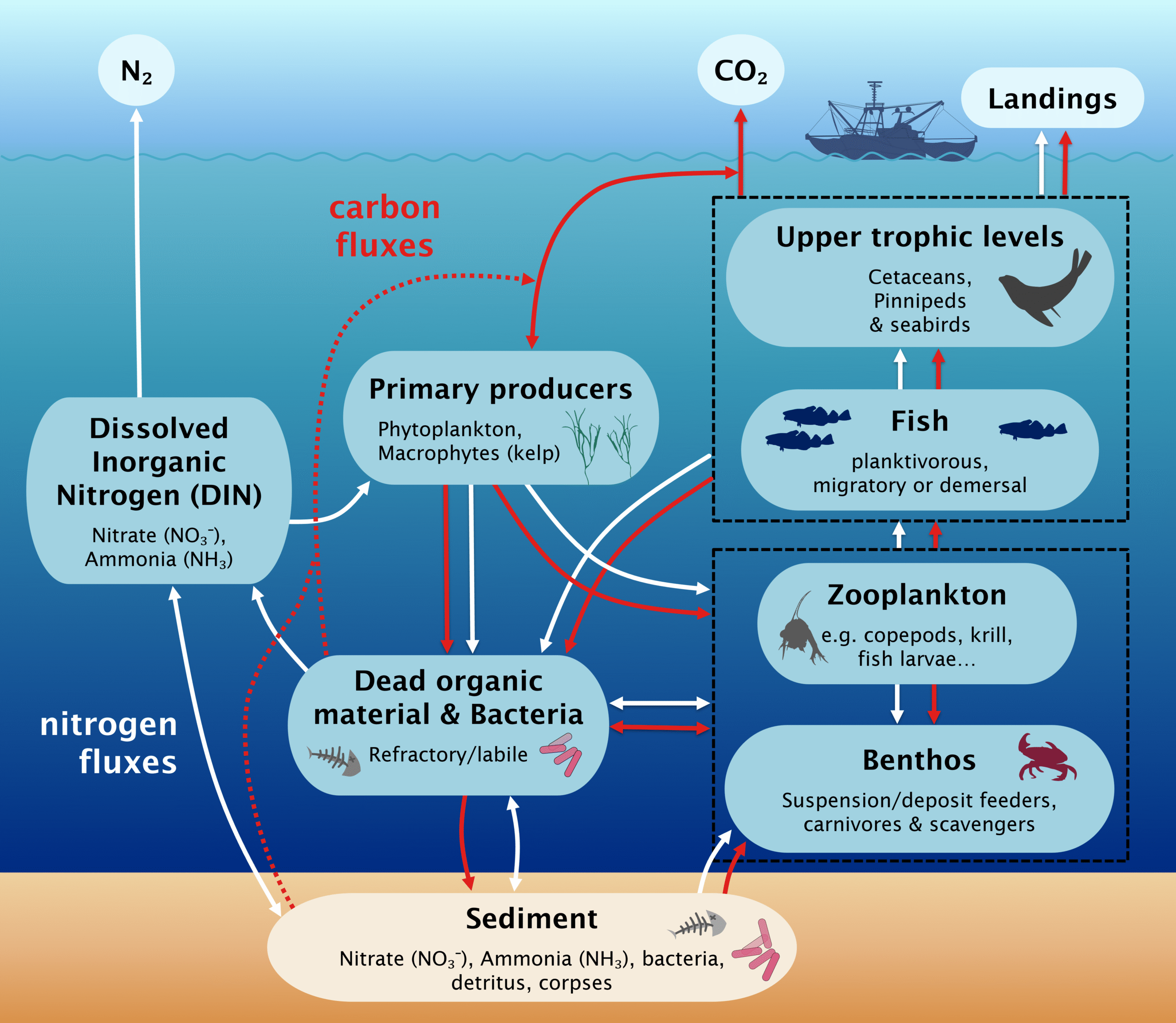
We decided to test the use of a dynamic C:N ratio on post-processing StrathE2E outputs from nitrogen to carbon fluxes. StrathE2E is an end-to-end coastal ecosystem model, describing food web interactions from phytoplankton, zooplankton and bacteria to benthos (seabed-living organisms), fish and top predators like pinnipeds (seals), cetaceans and seabirds (you can play with an online version of the model here.)
The model also simulates diverse fishing activities and includes seabed disturbance from trawling. In the schema below, you can see a simplified representation of all nitrogen fluxes described in StrathE2E (white arrows), and the conversion algorithm is computing their equivalence in carbon (red arrows). The developed algorithm was able to simulate the drop in C:N ratio in consumers (benthos, zooplankton, fish and upper trophic levels/top predators) when going up the food web, as seen in stoichiometric observations, while keeping the C:N ratio of phytoplankton at the Redfield value.
How big is the difference in ocean carbon sequestration estimates which use the Redfield ratio compared to this new algorithm?
Compared to the StrathE2E carbon estimates obtained with the conversion algorithm, a simple conversion using the Redfield ratio for all fluxes would underestimate carbon sequestration by about 4% on average. In the Celtic Sea, this would be a difference of about 1 gram of carbon per meter squared per year.

Dr. Emma Dolmaire
Dr. Emma Dolmaire is a modeller in marine ecology and fishery. She has worked in the past on spatial population models and has recently joined the StrathE2E ecosystem modelling team at the University of Strathclyde to be part of the OceanICU project. Her work focuses on the impact of fishing on fish populations and ecosystem carbon budget.
Data Sources:
Acevedo-Gutierrez, A., Kennish, J. M., Levin, P. S., Lance, M. M., Jeffries, S. J., and Bromaghin, J. F. (2012) Isotope ratios of carbon and nitrogen from harbor seals and prey species analyzed at the Stable Isotope Core Laboratory in Pullman, WA in 2009 (Seal_response_to_prey project). Biological and Chemical Oceanography Data Management Office (BCO-DMO). (Version 04 December 2012) Version Date 2012-12-04. http://lod.bco-dmo.org/id/dataset/3708 [03/05/2025]
Guo, J., Brugel, S., Andersson, A., and Lau, D. C. P. (2022) Spatiotemporal carbon, nitrogen and phosphorus stoichiometry in planktonic food web in a northern coastal area. Estuarine, Coastal and Shelf Science, 272. https://doi.org/10.1016/j.ecss.2022.107903
Koch, P. L., and McCarthy, M. D. (2016) Bulk Carbon and Nitrogen isotopes from sperm whale dentin from the UC-Santa Cruz labs of P. Koch and M. McCarthy (Sperm Whale SI Ratios project). Biological and Chemical Oceanography Data Management Office (BCO-DMO). Version Date 2016-08-01. http://lod.bco-dmo.org/id/dataset/652931 [03/05/2025]
Rynearson, T. (2019) Elemental carbon and nitrogen data for Skeletonema species as analyzed in Anderson and Rynearson, 2020. Biological and Chemical Oceanography Data Management Office (BCO-DMO). (Version 1) Version Date 2019-10-30. doi:10.1575/1912/bco-dmo.780386.1 [03/05/2025]
Schiettekatte, N. M. D., Barneche, D. R., Villéger, S., Allgeier, J. E., Burkepile, D. E., Brandl, S. J., Casey, J. M., Mercière, A., Munsterman, K. S., Morat, F., and Parravicini, V. (2020) Nutrient limitation, bioenergetics and stoichiometry: A new model to predict elemental fluxes mediated by fishes. Functional Ecology, 34(9), 1857–1869. https://doi.org/10.1111/1365-2435.13618
Vanni, M. J., McIntyre, P. B., Allen, D., Arnott, D. L., Benstead, J. P., Berg, D. J., Brabrand, A., Brosse, S., Bukaveckas, P. A., Caliman, A., Capps, K. A., Carneiro, L. S., Chadwick, N. E., Christian, A. D., Clarke, A., Conroy, J. D., Cross, W. F., Culver, D. A., Dalton, C. M., … Zimmer, K. D. (2017) A global database of nitrogen and phosphorus excretion rates of aquatic animals. Ecology, 98(5), 1475. https://doi.org/10.1002/ecy.1582