By Carla Freitas
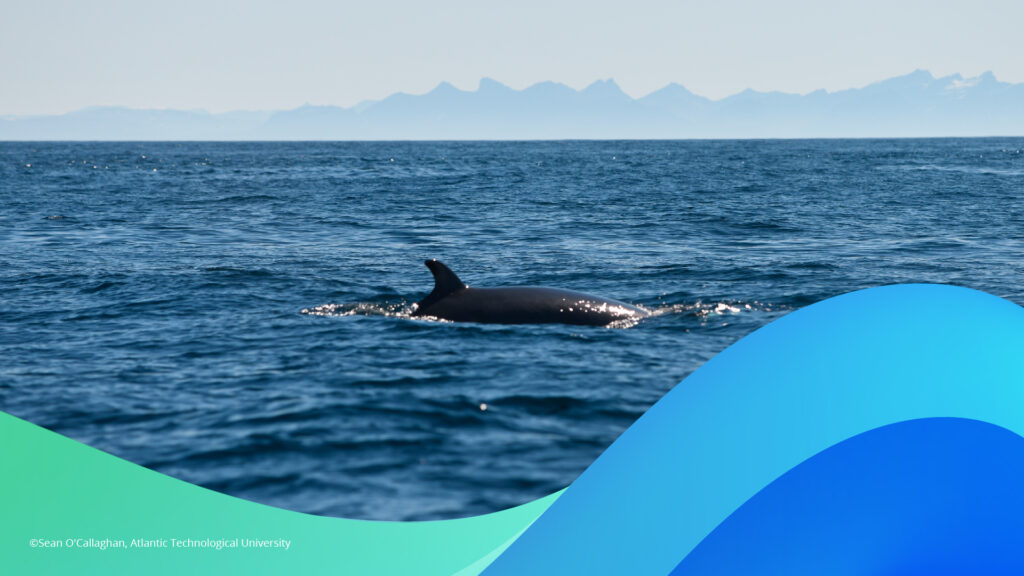
Dr. Carla Freitas (IMR) studied the diving behaviour of common minke whales and fin whales at the coast of Northern Norway and the impact of whale-released nutrients on ocean primary production. Results from this research have been published in two research articles. OceanICU had a friendly chat with her to find out what the key outcomes of this work are.
What does your recent research focus on?
My research within OceanICU focuses on quantifying how whales contribute to nutrient and carbon cycling in the ocean. Specifically, we have been studying three key carbon pathways associated with whales:
- the enhancement of primary production through nutrient recycling from whale excreta (the whale pump);
- carbon export through whale falls (carcasses of whales that sink to the seafloor);
- the sinking of carbon via whale fecal pellets.
You have studied the diving behaviour of common minke whales and fin whales at the coast of Northern Norway. What have you learned about how deep they dive and their diving behaviour?
By tracking common minke whales and fin whales in high-latitude summer feeding grounds, we found that these species forage at depths that can exceed 100 m, but spend most of their time (50-80%) near the surface. This suggests that most nutrients inputs from feces and urine are released at the surface layer, where they become available to phytoplankton and other primary producers.

You have also studied the impact of whale-released nutrients on ocean primary production. What are the factors that come into play? What are the key outcomes of this study?
Whales have long been thought to enhance ocean productivity by recycling essential nutrients through their excreta, but their quantitative contribution to primary production has remained uncertain. In this study, we quantified nutrient release from both whale feces and urine by baleen whales in high-latitude feeding grounds and assessed its impact using ecosystem models. Our results indicate that whales enhance ocean productivity, particularly in offshore regions where nutrients are scarce, leading to cascading effects on the food web. These findings highlight the ecological importance of whale-mediated nutrient cycling and emphasize the role of whale populations in sustaining productive and resilient marine ecosystems.

Former studies show that whales consume considerable amounts of fish. How does your research contribute to the discussion regarding whale impact on fish resources?
Baleen whales consume large amounts of fish and krill during the summer feeding season, in contrast to the breeding season at low latitudes, when they fast. Recent research shows that increasing whale populations do not inherently reduce fish biomass. Our research helps explain why.
As whales feed, they recycle nutrients through their feces and urine, stimulating phytoplankton and zooplankton production, thus supporting marine food webs. In this way, whales do not simply remove biomass, they also help regenerate the resources they depend on — a nutrient-recycling process that has shaped marine ecosystems for millions of years.
Fisheries, by contrast, remove both fish biomass and the nutrient pool available to sustain future productivity. As a result, whale predation and fisheries harvest have fundamentally different ecological consequences: whales recycle nutrients within the ecosystem, whereas fisheries export biomass and nutrients out of it.
You wrote a blog post for OceanICU in 2023 which was titled ‘How Important Are Whales in the Oceanic Carbon Cycle?’ How has your understanding of the impact of whales on ocean carbon evolved since this blog?
Since that blog post, our understanding has become much more comprehensive. In our initial study, we quantified the nutrient content of whale feces. We have now expanded this work by quantifying nutrient release from both feces and urine and found that urine is the dominant source of nitrogen – the main nutrient limiting primary production in our study area. Importantly, urinary nitrogen is released in a dissolved, bioavailable form that can be directly utilized by primary producers. Additionally, by combining our measurements with ecosystem models, we have been able to estimate the overall contribution of whale-released nutrients to ocean primary production across different regions and seasons.
What are the key points that you think we should all remember about the role of whales in the ocean carbon cycle?
Whales play an important role in the ocean carbon cycle by recycling nutrients that fuel primary production. This process supports marine food webs and contributes to the biological carbon pump, helping to transfer carbon from the atmosphere to the deep ocean. Healthy whale populations therefore provide important ecosystem services that benefit both marine biodiversity and carbon sequestration.
Are there still gaps in understanding the role of whales in the ocean carbon cycle? What are they? What are your next steps to address these gaps?
Yes, there are still important knowledge gaps. Our next steps are to estimate carbon sequestration associated with whale falls, which transport carbon to the deep ocean when whales die, as well as to quantify the sinking rates and carbon export associated with whale fecal pellets. Together, these studies will provide a more complete understanding of how whales contribute to long-term ocean carbon storage.
For further information, read the following two research articles.
- Eide, S., Rikardsen, A. & Freitas, C. Comparative diving patterns of two minke whales (Balaenoptera acutorostrata) and two fin whales (Balaenoptera physalus) in Northern Norway. Anim Biotelemetry 13, 40 (2025). link.springer.com/article/10.1186/s40317-025-00432-2
- C. Freitas, M.D. Skogen, G.M. Sigurðsson, M. Biuw, T. Haug, L. Lindblom, & K. Gundersen, Impact of baleen whales on ocean primary production across space and time, Proc. Natl. Acad. Sci. U.S.A. 122 (43) e2505563122, https://doi.org/10.1073/pnas.2505563122 (2025).
As OceanICU moves through its fourth year, activity is being tracked against Impact Clusters. Carla’s research supports Cluster 1: Biology in Carbon Cycle, which includes undertaking research focussed on understanding key biological carbon cycling processes, creating mathematical representations of these and incorporating them into models.

Carla Freitas
Dr. Carla Freitas is a senior scientist at the Institute of Marine Research in Norway. She has a PhD from the University of Tromsø (Norway), and a MSc. in Marine and Fisheries Science from the University of Aberdeen (UK). She specialises on spatial ecology of marine top predators, with an emphasis on how these species use their environment and their ecological role in marine ecosystems – including their impact on the ocean carbon cycle.