The twin crises of biodiversity loss and climate change are often treated as inextricably linked. However, this perspective has largely been developed from terrestrial systems, with the ocean receiving far less attention. Despite its central role in regulating climate and supporting global food security, the contribution of ocean biodiversity and the consequences of its loss, remain under-recognised.
This gap was the focus of a two-day Royal Society Discussion Meeting held in London and organised by OceanICU colleagues Richard Sanders (NORCE), Alex Poulton (Heriot-Watt University), Stephanie Henson (National Oceanography Centre), Alessandro Tagliabue (University of Liverpool); as well as Emma Cavan (Imperial College London). The meeting brought together researchers from across disciplines to explore how ocean biodiversity loss influences climate regulation and food security.
The Panel discussion featuring Richard Sanders (NORCE) as moderator and Professor Corinne Le Quere(University of East Anglia), Professor Deborah Steinberg (Virginia Institute of Marine Science), Professor William Cheung (The University of British Columbia), Dr Sophie Clayton (National Oceanography Centre) as panellists.
Across both days, discussions were characterised by big thinking and knowledge sharing, with a focus on the barriers preventing the marine biodiversity-climate link from receiving the recognition it deserves.
Day One
Does ocean biodiversity matter and what regulates it?
The first day of the meeting focused on recent research in response to the above question, and presentations and discussions unpacking a range of topics at the heart of the marine biodiversity-climate interface.
These included:
Nature-based solutions are essential to a climate resilient pathway
The trade-offs and synergies in the marine food-climate-biodiversity nexus
Understanding the drivers of coral reef biodiversity
Variable linkages between biodiversity and stoichiometry in the plankton
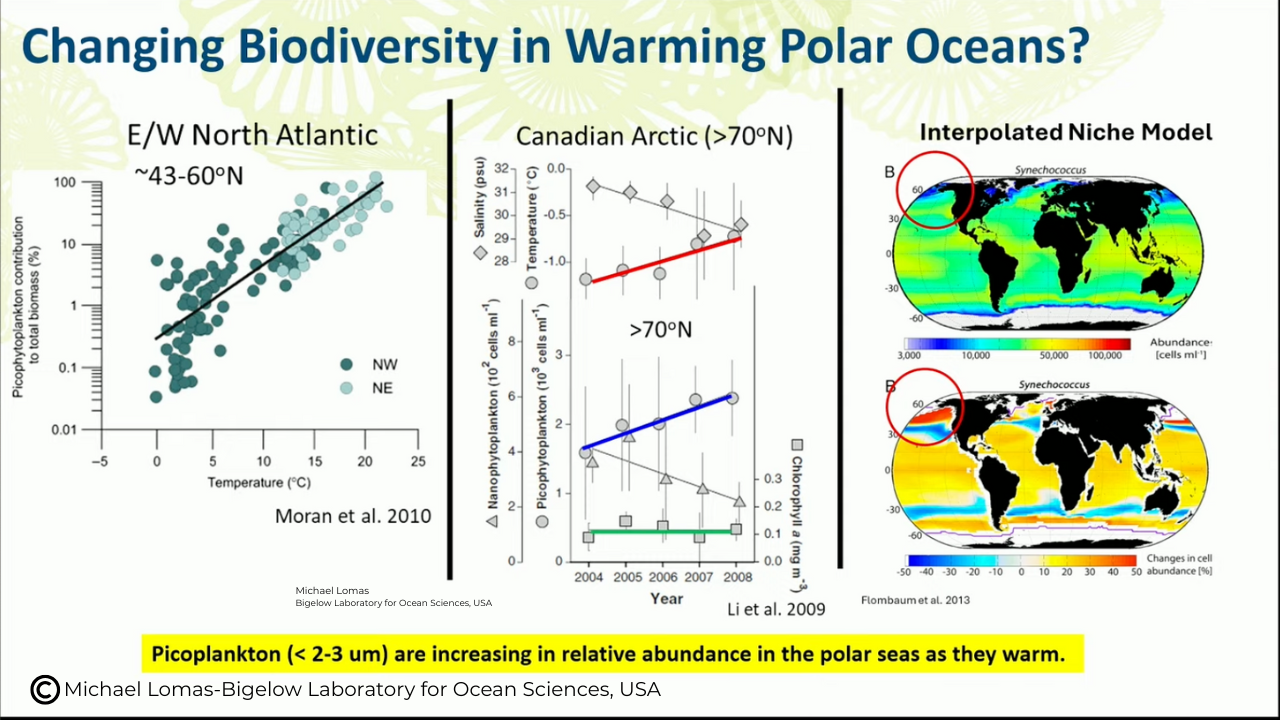
Warming-driven shifts in North Atlantic plankton
How to incorporate mixotrophy and microbial functional diversity into ocean biogeochemical models
While well-known biogeographical patterns drive cryptobiome richness, the role of fishing, cyclones and thermal history need to be better understood.
While understanding what regulates reef biodiversity is becoming better understood, improved models with new data types are needed
Rebecca Millington, Jim Clark, Caglar Yumruktepe, Angus Atkinson, Helen Powley, Gennadi Lessin, Jerry Blackford, Robert Wilson, Andrea Rochner, Susan Kay.
Thomas Ryan-Keogh, Alessandro Tagliabue, Sandy Thomalla.
Michael Lomas-Bigelow Laboratory for Ocean Sciences, USA.
Reflecting on the first day, OceanICU Coordinator Richard Sanders (NORCE) commented, “It’s been really exciting to chair this meeting which brings together scientists from across the world to discuss the key issues of climate change and biodiversity loss. There have been some great contributions from OceanICU already, and I’m looking forward to day two and the panel discussion, which promises to be exciting, with an important output being a consensus on priority research themes.”
Day Two
Does biodiversity affect ecosystem performance/ productivity?
The second and final day addressed the above question, bringing forth insightful research, a journey back in time to see what we can learn from fossils, and new ideas to address key challenges facing biodiversity and climate.
Presentations focussed on:
How does harvesting marine ecosystems influence ocean carbon cycle and global climate?
Linking ecosystem structure and production to carbon sequestration
Biodiversity in Twilight Zone functioning
Oceanographic drivers of carbon storage in European seagrass beds
Can mesopelagic fish become a safe, sustainable and profitable food source? Implications for managing ocean spaces for biodiversity and climate
Fossil biodiversity and ecosystem function: insights from marine plankton
Adaptive evolution and its impact on global phytoplankton diversity and productivity
Modelling ecosystem dynamics and carbon cycle interactions in rapidly changing environments.
Dr. Pedro Cermeno.
Professor Deborah Steinberg.
Professor Deborah Steinberg.
The meeting concluded with a panel discussion moderated by Alessandro Tagliabue (University of Liverpool), focusing on how models and meta-analyses can be used to address the interconnected challenges of climate change, biodiversity loss and food security across different ecosystem services, impacts and exposure.
The panel featured Professor Corinne Le Quéré (University of East Anglia), Professor Deborah Steinberg (Virginia Institute of Marine Science), Professor William Cheung (The University of British Columbia) and Dr Sophie Clayton (National Oceanography Centre).
Summarising the event in a closing note, Richard Sanders (NORCE) remarked on the complex challenges that had been raised throughout all the sessions stating “the ocean community can address these with new ideas and co-designed services, and the EDITO – European Digital Twin Ocean can support many of the suggested activities in a way that would have formerly required a lot of funding to achieve.”